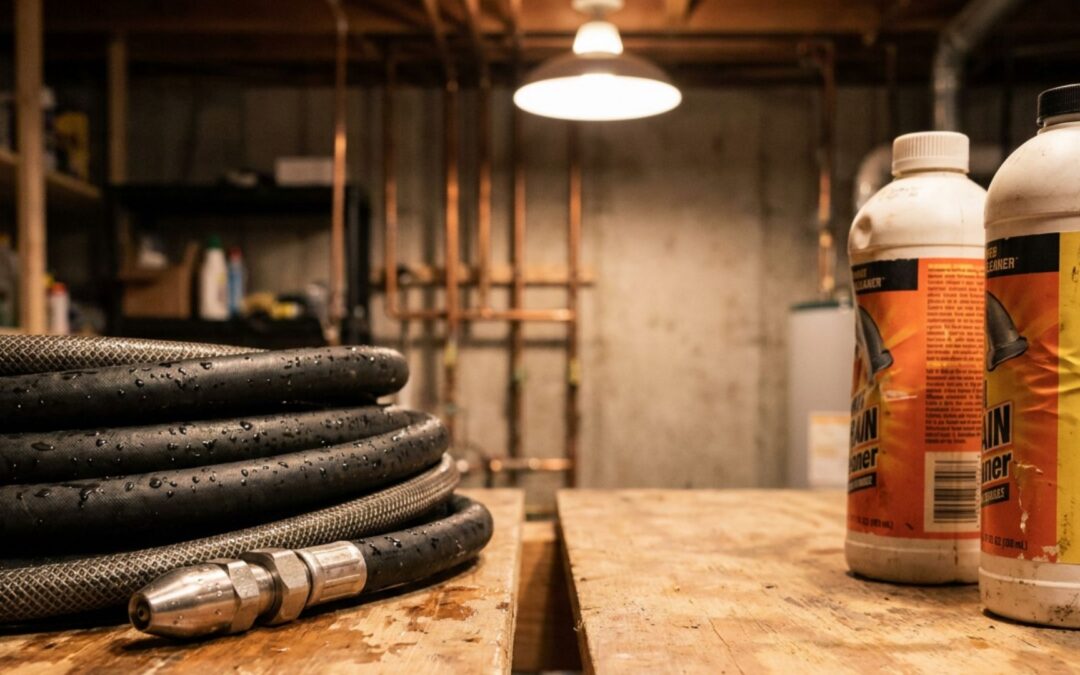
When a drain starts slowing down, most homeowners do the same thing first: they reach for the quickest fix. A bottle from the hardware store. A “max strength” label. A promise that the clog will disappear in 15 minutes. And sometimes, it does.
But in a lot of older Seattle-area homes, that quick win comes with a hidden cost. The pipe you’re pouring that chemical into may be decades old, already rough on the inside, and made of materials that don’t respond well to repeated chemical exposure.
This is where the conversation changes from “How do I clear this clog?” to “How do I clear it without damaging the system?” The answer is hydro jetting.
In this guide, the experts here at N.W. Sewer & Drain will break down the science (without getting lost in the weeds):
- What chemical drain cleaners actually do inside a pipe
- Why older pipe materials are more vulnerable
- How hydro jetting uses physics, not corrosion, to restore flow
- When each approach makes sense (and when it doesn’t)

The Story We See: The “One More Bottle” Cycle
A homeowner calls after months of recurring clogs. They’ve tried a plunger. They’ve tried a snake. They’ve tried chemical drain cleaner “one more time” because it worked last month.
Now the clog is worse, the smell is stronger, and they’re worried something bigger is happening. When we inspect the line, we often find two things at once:
- The original cause (grease, scale, roots, sludge)
- A pipe interior that’s getting rougher and more fragile over time
It’s not that chemical cleaners always cause the problem. It’s that they can accelerate wear in pipes that are already aging.
What’s Inside Your Drain Line (And Why It Matters)
Most residential clogs are a combination of:
- Grease and fats that cool and cling to pipe walls
- Soap scum that binds with minerals
- Hair and organic debris that forms a net
- Mineral scale (especially in older cast iron)
- Sludge and biofilm that coats the interior
In older homes, the pipe wall itself is often not smooth anymore. Cast iron can corrode and scale. Galvanized sections can roughen. Even older copper can thin in spots. That roughness reduces the effective diameter of the pipe and gives buildup more surface area to grab.
Chemical Drain Cleaners: The Chemistry Behind The Label
Most consumer and commercial drain cleaners fall into a few chemical categories.
Caustic cleaners (high pH)
Often based on sodium hydroxide (lye) or similar compounds.
What they do:
- Generate heat when reacting with water
- Break down organic material (hair, grease) through chemical reactions
- Turn some fats into soap-like compounds
Oxidizing cleaners
Often based on bleach-like oxidizers.
What they do:
- Oxidize organic matter
- Can be effective on certain types of soft clogs
Acidic cleaners (low pH)
Some products use strong acids.
What they do:
- Dissolve certain mineral deposits
- React aggressively with metals
The key point: chemical cleaners work by reaction. They don’t remove buildup by force. They alter it chemically, and that reaction doesn’t always stop at the clog.
How Chemical Cleaners Can Damage Older Pipes
In older Seattle-area homes, you’re more likely to have cast iron drain lines, galvanized steel sections, older copper, or mixed-material transitions.
Chemical cleaners can create risk in a few ways.
Heat Plus Corrosion Can Accelerate Wear
Many caustic cleaners generate heat as they react. That heat, combined with an already-corroded interior surface, can accelerate degradation.
In cast iron, the interior wall may already be pitted. Repeated exposure to harsh chemicals can worsen that pitting over time.
Chemical Attack on Alloys and Joints
Older plumbing systems often include metal alloys in fittings, transitions, or older components.
- Attack protective oxide layers
- Increase corrosion rates
- Weaken joints and seals over repeated use
Even if the pipe doesn’t fail immediately, it can become more vulnerable to cracks, leaks, and roughness that catches debris.
Chemicals Don’t Solve Diameter Loss
Chemical cleaners can sometimes punch a hole through a soft clog, but they rarely restore the pipe to a healthier interior condition.
If your line is narrowed by scale, grease layers, or sludge coating, you’re still operating with reduced diameter. The clog returns because the environment that caused it never changed.

Safety Hazards During Professional Service
If a chemical cleaner is sitting in a trap or line and you later call a professional, it can create hazards:
- Chemical splash risk
- Fumes
- Dangerous reactions if mixed with other products
This is one reason many pros recommend avoiding chemical cleaners, especially repeatedly.
Hydro Jetting: The Physics of Cleaning Without Corrosion
Hydro jetting is different because it doesn’t rely on chemical reaction. It uses high-pressure water and specialized nozzles to clean the inside of the pipe. The core physics at work:
- Pressure (force per unit area) delivers energy to the buildup
- Flow rate carries loosened debris out of the line
- Directional jets create shear forces that peel buildup off pipe walls
- Turbulence helps break up stubborn deposits
Instead of “eating” the clog, hydro jetting mechanically removes it.
“Restoring Original Diameter”: What That Really Means
No cleaning method can reverse metal loss from decades of corrosion. But hydro jetting can often remove the layers that are stealing your usable diameter.
Imagine a 4-inch pipe that has accumulated a thick ring of grease and scale. Your effective flow path might be closer to 2.5 to 3 inches.
Hydro jetting can strip away that ring so the pipe flows closer to its intended capacity. That’s why homeowners often notice:
- Faster draining
- Fewer recurring clogs
- Less odor
- Better performance across multiple fixtures
When Hydro Jetting Is the Better Choice
Hydro jetting is often ideal when:
- You have recurring clogs
- Grease buildup is heavy
- Sludge and biofilm is coating the line
- You want a more complete clean than snaking
It’s also commonly used as a prep step before certain repairs because it gives a clearer view of the pipe condition.
When Hydro Jetting Is Not the Right First Step
Hydro jetting is powerful, and that’s why it should be used appropriately. A sewer camera inspection helps confirm whether the line can handle jetting safely. Hydro jetting may not be recommended if:
- The pipe is collapsed
- There are severe offsets
- The line is extremely fragile
- Roots are extensive and the pipe is structurally compromised
That’s why a professional approach starts with seeing the line, not guessing.
The Plan: Clear The Clog, Protect the System
If you’re dealing with recurring drain issues in an older home, here’s a simple plan that keeps you from bouncing between quick fixes.
- Stop the chemical cycle
- Inspect the line
- Choose the least invasive solution that actually lasts
- Address underlying pipe issues if needed
Chemistry Is Fast, Physics Is Thorough: Contact N.W. Sewer & Drain for Hydro Jetting Services
Chemical drain cleaners can sometimes create a quick opening in a soft clog, but they can also introduce heat, corrosion risk, and repeated exposure that isn’t kind to older pipe materials.
Hydro jetting, on the other hand, uses controlled water pressure and flow to remove buildup mechanically. It often restores much more of the pipe’s usable diameter without relying on corrosive reactions.
If you’re in Seattle or the Greater Seattle area and you want a real answer on what’s happening in your drains, N.W. Sewer & Drain can inspect the line, explain the findings clearly, and recommend the safest next step. To schedule service or ask a question, contact N.W. Sewer & Drain for help.